Adhesive-Based Flex: Constraints, Tradeoffs, and Decision Drivers in Mil-Aero Programs
Should a flexible circuit be fabricated using adhesive-based or adhesiveless materials?
In Part 1 of this series, we established adhesiveless flex laminates as the baseline for high-reliability aerospace and defense applications. However, not all flex designs demand or are funded to achieve the highest performance levels.
This article examines adhesive-based flex PCB materials, outlining where they can be viable, the limitations they introduce, and the system-level considerations required when evaluating their use in mil-aero programs.
Adhesive-Based Flex Construction
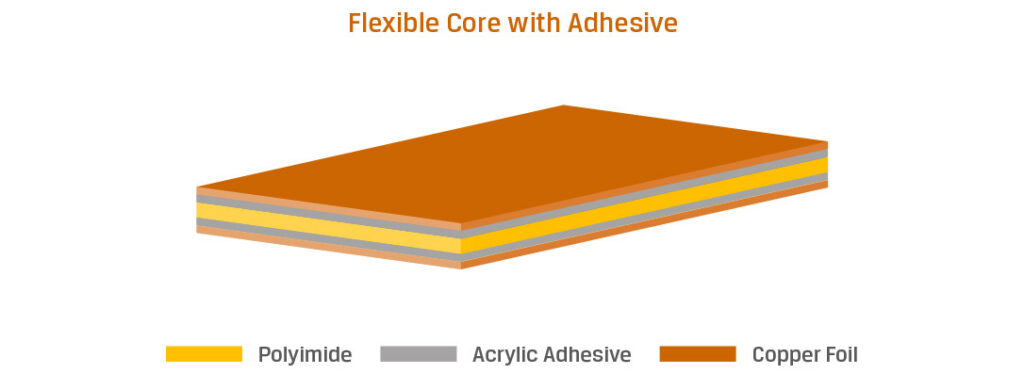
Adhesive-based flex laminates use copper bonded to polyimide through an acrylic or epoxy adhesive layer. This construction is common in commercial electronics and certain defense support equipment due to lower material costs and well-established fabrication processes.
However, in mission-critical environments, adhesive layers introduce additional variables that require careful management.
Benefits and Limitations of Adhesive-Based Flex
Lower material cost
Particularly beneficial in larger, simpler interconnects where reliability demands are modest.
Straightforward fabrication
Well-established processes, broad supplier availability, and compatibility with common FPC (Flexible Printed Circuit) layer constructions.
Thermo-mechanical instability
Adhesives exhibit higher coefficients of thermal expansion and can become failure points during high-temperature operation or rapid thermal transitions.
Reduced bend performance
Thicker constructions and less ductile adhesive layers limit suitability for dynamic or tight-radius bending applications.
Delamination risk
Exposure to vibration, aerospace thermal cycling, vacuum bake-out, or other environmental stresses can increase the risk of layer separation.
Less predictable impedance performance
Adhesive dielectric thickness can vary more significantly than adhesiveless laminates.
Appropriate Use Cases for Adhesive-Based Flex
For customers engaged in dedicated-service, Class 2 reliability programs, Pioneer Circuits provides adhesive-based flex solutions for applications driven by cost constraints or higher-volume production requirements. These designs still require defined qualification testing, including thermal cycling, vibration, peel strength, and moisture conditioning.
Typical applications include:
- Static-bend flex circuits used as shaped interconnects
- Non-mission-critical subsystems with benign environments
- Lower-density routing where mechanical stresses are minimal
- Ground-support electronics or test equipment where cost efficiency matters
Decision Drivers for Mil-Aero Programs
When selecting between adhesive-based and adhesiveless materials, engineers should evaluate the following system-level factors:
Mechanical Environment
- Dynamic bending → adhesiveless
- Random vibration exposure → adhesiveless preferred
- One-time installation bend only → adhesive-based acceptable with caution
Thermal Environment
- Wide temperature ranges (–55 °C to +125/+150 °C) → adhesiveless
- Exposure to vacuum, outgassing limits (e.g., ECSS-Q-ST-70-02) → adhesiveless
- High dwell or dwell-cycling → avoid adhesive-based when possible
Electrical Performance Requirements
- Controlled impedance lines (RF, high-speed digital) → adhesiveless strongly preferred
- Noise-sensitive or timing-critical signals → adhesiveless
Reliability Requirements
- Long-life systems (20+ years) → adhesiveless
- Safety-critical hardware → adhesiveless
- Mission-critical or no-repair applications → adhesiveless is typically mandatory
Cost Considerations
Adhesive-based materials may appear cheaper on a BOM, but often erase the perceived cost benefit for Mil-Aero hardware due to:
- Lower yields
- Higher scrap rates
- Increased rework
- Tighter process windows
Program Leads and Design Engineer Recommendations
- Use adhesiveless laminates as the baseline for mission-critical systems
- Specify material types early to avoid costly redesign during qualification
- Engage supplier engineering teams before finalizing stack-ups
- Align qualification testing rigor with material risk
- Document bend conditions and installation procedures early