Adhesiveless as the Baseline for High-Reliability
Mil-Aero Systems
Should a flexible circuit be fabricated using adhesive-based or adhesiveless materials?
In aerospace and defense environments where thermal extremes, vibration, radiation exposure, outgassing constraints, and long-term reliability converge, this choice carries significant implications. Material selection is not merely a cost consideration, it is a system-level reliability decision that directly affects mechanical durability, electrical stability, and mission readiness.
This first entry in a two-part Pioneer Insights series focuses on adhesiveless flex PCB materials and explains why they are widely regarded as the preferred baseline for high-reliability mil-aero applications.
Adhesiveless Flex Construction
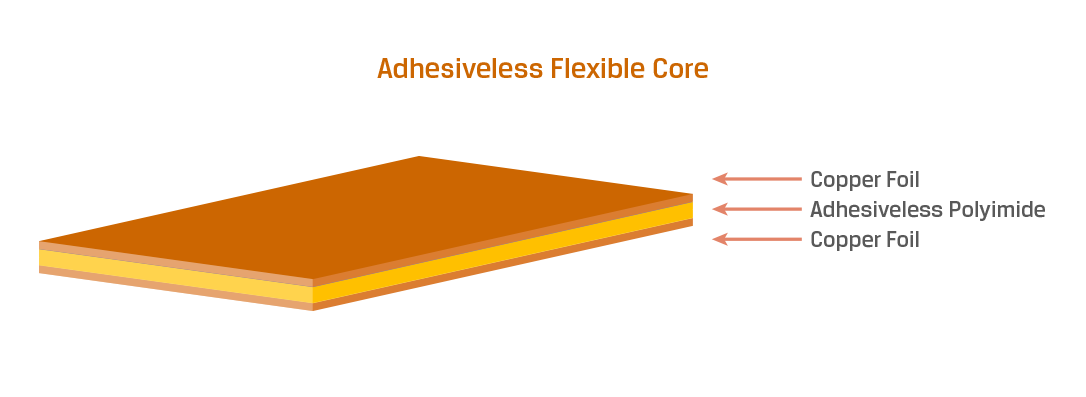
Adhesiveless polyimide flex laminates are manufactured by directly bonding copper to polyimide without an intermediate adhesive layer. By eliminating this layer, adhesiveless constructions remove a common source of thermo-mechanical and electrical variability present in traditional adhesive-based flex circuits.
Performance Advantages of Adhesiveless Flex:
Superior mechanical durability
Rolled-annealed copper and thin dielectrics support significantly tighter bend radii, reducing the risk of stress cracking during repeated flex cycles or random vibration events.
Dimensional stability under thermal load
Adhesiveless laminates exhibit lower Z-axis expansion and more predictable XY behavior; critical for assemblies exposed to thermal shock, sustained high-temperature operation, or vacuum environments.
Dimensional stability under thermal load
Improved signal integrity and impedance consistency
The absence of an adhesive layer reduces dielectric constant (Dk) variability, enabling tighter control of controlled-impedance transmission lines important in radar, satcom, navigation, and high-speed digital avionics.
Enhanced reliability at solder joints and interconnect transitions
Direct copper-to-polyimide bonding eliminates one of the common failure points under thermal cycling and HALT (Highly Accelerated Life Test)/HASS (Highly Accelerated Stress Screen) profiles.
Typical Mil-Aero Applications for Adhesiveless Flex
For most high-reliability programs, adhesiveless constructions are selected unless cost or configuration constraints require otherwise. Common applications include:
- Dynamic-bend flex in gimbals, seeker heads, and UAV flight controls
- High-density or fine-pitch routing for compact mission electronics
- Impedance-controlled RF or high-speed digital pathways
- Spaceflight hardware where outgassing and thermal extremes are critical
- Any flex expected to exceed a single controlled bend during installation
While adhesiveless constructions serve as the reliability baseline for most mission-critical flex applications, adhesive-based materials are not obsolete. They remain present in select designs where cost sensitivity, thickness requirements, or specific fabrication constraints influence material selection.
Part 2 of this series examines adhesive-based flex constructions in detail. Including where they remain viable, the associated reliability tradeoffs, and the engineering criteria that should guide material selection decisions.